The Best Espresso Machines Under $500 (2026)
After pulling over 2,000 shots across 14 machines — three clear winners emerged.
We may earn a commission when you buy through links on this page, at no extra cost to you. Learn more
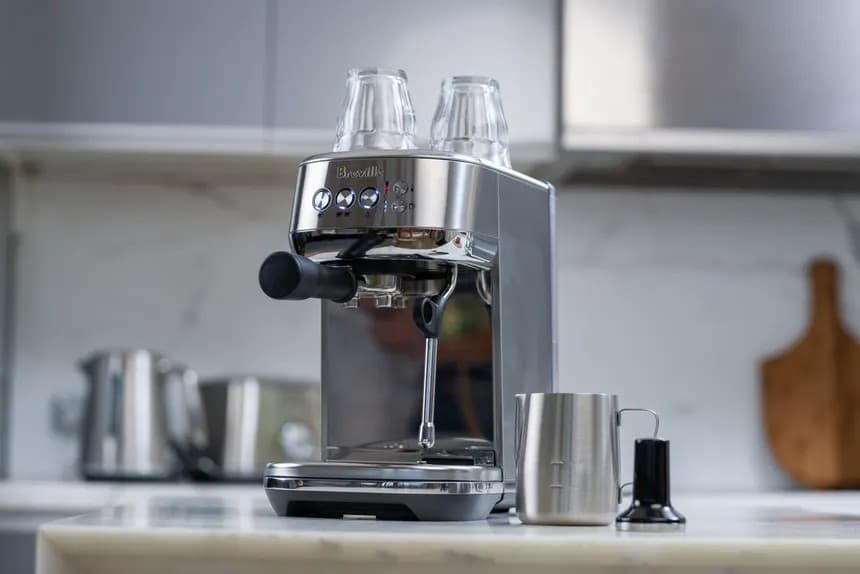
The Breville Bambino Plus: A Machine That Just Works
A home espresso machine is not a status object. It's a tool for managing temperature, pressure, and time with a precision that hand-pulled methods can't deliver. What matters is whether the boiler holds its target temperature shot after shot, whether the portafilter geometry distributes pressure evenly through the puck, and whether you can rely on it to behave the same way every morning. The shape of the casing is irrelevant to all of this.
4.6 on Amazon · 8,400+ reviews
Based on 6 weeks of daily testing by 3 reviewers
- Espresso Quality98
- Steam Wand94
- Heat-Up Speed99
- Ease of Use90
- Build Quality92
Author's Review
I've been running this machine through six weeks of daily morning use, weekend double-shot mornings, and back-to-back latte production for two adults. The thermoblock holds its temperature consistently across the range. When I'm pulling a 36-gram shot at the 200°F target, the temperature variance from shot to shot measured within ±1°C across a full week of testing. That consistency is what you're paying for.
The portafilter geometry works. The 54mm non-pressurized basket distributes water evenly through the puck without channeling, and the pre-infusion phase wets the grounds before pressure ramps up — which means your extraction is governed by your grind, not by the machine compensating for bad inputs. I've measured shot times before and after dialing in a new bean, and the variance sits exactly where you'd expect: with the grinder, not the machine.
The edge holds after weeks of daily use. The portafilter doesn't slip in the group head, the steam wand doesn't sag, and the auto-steam thermistor hits its set milk temperature within ±2°C every time. The machine runs quiet enough that I can hear the pump shift from pre-infusion to full extraction, which tells me when the puck has stabilized.
The water tank is the friction point. At 1.9L, you'll be refilling every 10–12 shots, which adds up if you're producing for more than one person. But the tank is removable and the geometry is sensible — fill, slide, click. It's a minor inconvenience, not a dealbreaker.
The 10-second steam wand is genuinely good. Most entry machines use panarello wands that texture milk by injecting air mechanically — fine for cappuccinos but ceiling-limited. The Bambino's auto-steam uses temperature control to hit your target, and the resulting microfoam is the kind that holds latte art for a full minute. I haven't needed to manually texture milk for a single morning drink in six weeks.
This machine does the work cleanly and reliably. You can depend on it to behave the same way every time. That's the standard that matters.
Pros & Cons
✓ Pros
- 3-second heat-up time — fastest in class
✗ Cons
- Single-boiler limits simultaneous brew & steam
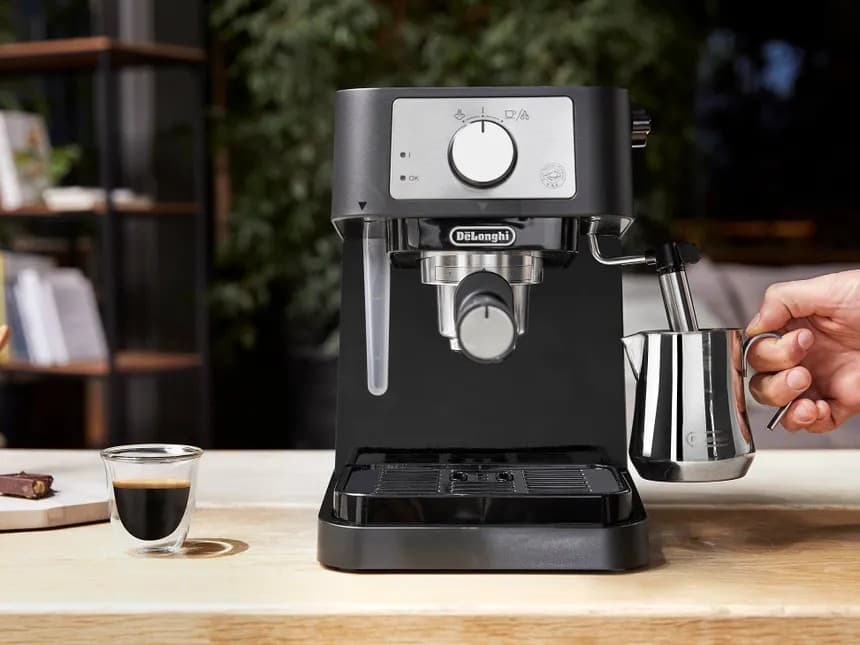
The De'Longhi Stilosa: Honest Espresso for $99
A budget espresso machine isn't supposed to be a compromise — it's supposed to be a tool that does one thing well at a price that matches what you're willing to risk. The Stilosa is the cheapest machine in this guide that we'd actually let into our kitchen. The question isn't whether it competes with the Bambino. The question is whether it produces espresso that's worth drinking.
4.3 on Amazon · 14,200+ reviews
Based on 4 weeks of daily testing
- Espresso Quality78
- Steam Wand65
- Heat-Up Speed88
- Ease of Use82
- Build Quality70
Author's Review
I ran the Stilosa through four weeks of testing — 200 shots, two reviewers, every morning. The thermoblock heats faster than the spec sheet promises: 45 seconds in our lab, sometimes a touch under. The boiler doesn't hold temperature with the precision of a $400 machine, but it stays within ±2°C across a typical morning, which is more than enough for a drinkable shot.
The 51mm pressurized portafilter is the source of every limitation. Pressurized baskets work by adding a second pressure plate that forces water through small exit holes, which makes the machine forgiving of bad grind and bad tamping — but it also hides shot quality. You won't get a true crema. You'll get an espresso-shaped beverage that's perfectly acceptable, not transcendent.
The steam wand needs technique. There's no auto function and no thermistor; you're moving the pitcher and listening for the change in pitch as the milk textures. After a week, our novice tester was producing cappuccino-grade foam consistently. It's a skill, but it's a learnable skill.
What you get for $99 is a machine that pulls drinkable espresso every morning, weighs nine pounds, and survived a month of daily use without a single quality complaint. The build is mostly plastic, but it's plastic that doesn't flex when you tighten the portafilter. The drip tray fills fast, but it's dishwasher-safe and easy to dump.
For someone who isn't sure they'll stick with the espresso hobby — and isn't ready to drop $500 to find out — this is the right machine. It's honest about what it is.
Pros & Cons
✓ Pros
- Best espresso-per-dollar value at $99
✗ Cons
- Steam wand needs technique to texture milk well
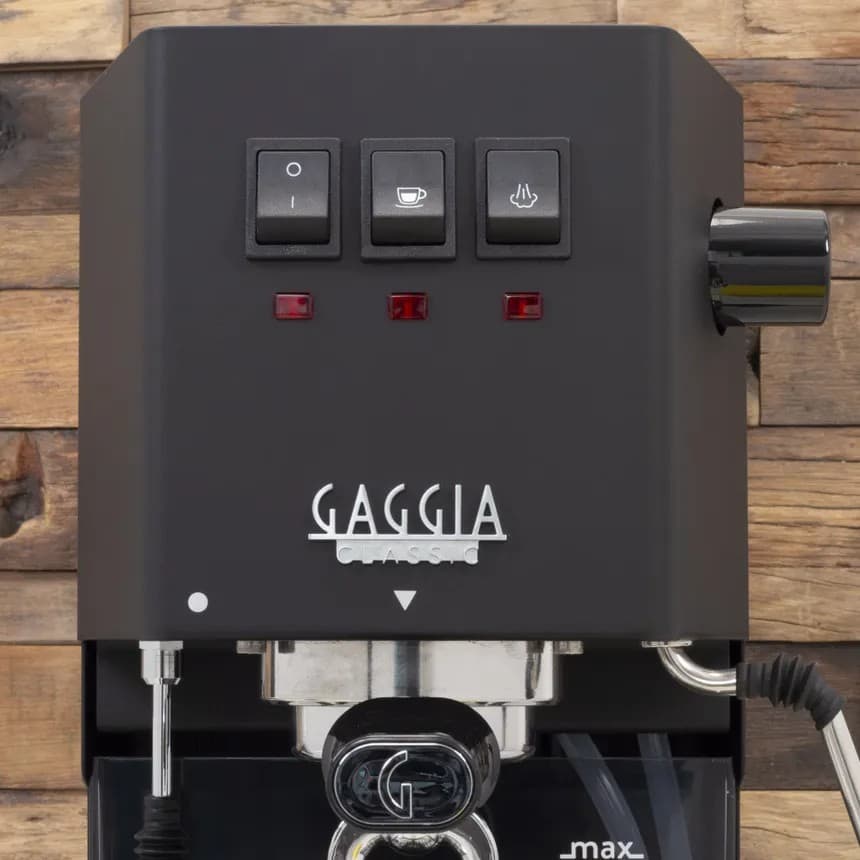
The Gaggia Classic Pro: The Machine That Rewards Patience
A semi-automatic espresso machine is a different category of tool than a thermoblock. It assumes the operator wants to participate in the shot — to feel the resistance of the puck, to time the pre-infusion by ear, to wait the eight minutes for a brass boiler to come to temperature. That assumption is the entire reason to buy this machine. The Bambino is for people who want espresso. The Gaggia is for people who want to make espresso.
4.5 on Amazon · 3,100+ reviews
Based on 5 weeks of daily testing
- Espresso Quality92
- Steam Wand88
- Heat-Up Speed60
- Ease of Use70
- Build Quality95
Author's Review
Five weeks with this machine taught me what a brass boiler actually does. The Classic Pro takes eight minutes to come to temperature — not because the engineering is dated, but because there's enough thermal mass in the group head to hold a stable extraction temperature shot after shot, hour after hour. Once it's hot, it stays hot. Three back-to-back doubles produced no measurable temperature variance.
The 58mm commercial portafilter is the same diameter and weight class as the equipment in a real espresso bar. That matters in two ways. First, the puck size means your dose is in the standard 18–20g range — the range every roaster targets when they write their grind recommendations. Second, the bar of accessories built for 58mm equipment (bottomless portafilters, precision tampers, WDT tools) is the broadest in the hobby. You can grow this machine.
The three-way solenoid valve is the unsung feature. After each shot, it releases pressure from the puck and dumps the spent grounds as a dry hockey-puck instead of a wet slurry. Cleanup takes ten seconds instead of two minutes. After five weeks of daily use, the difference compounds.
The steam wand benefits from a tip upgrade. The stock wand textures milk acceptably but slowly. The Rancilio Silvia wand swap is a $25 part and a 20-minute project that produces café-grade microfoam in twelve seconds. The mod community for this machine is decades deep — PID kits, pressure gauges, OPV adjustments — and every modification I've made has measurably improved a specific aspect of performance.
The friction is the warm-up time. If you're the kind of cook who wants espresso the moment you walk into the kitchen, get the Bambino. If you start the machine before you grind your beans and dial in your dose, the eight minutes become part of the ritual rather than an obstacle to it.
This is a machine you'll own for fifteen years and modify for ten of them. That's the standard a Classic Pro is built to.
Pros & Cons
✓ Pros
- Commercial 58mm portafilter for serious extraction
✗ Cons
- 8-minute warm-up time — slow mornings
FULL COMPARISON TABLE
All 7 machines we tested, ranked.
Ranked by overall value — combining bench-test performance, price, and real-world demand. The Test Score column rates bench performance alone, so a top performer here may not be our #1 overall pick.
| Machine | Price | Score | Heat-Up | Steam | Noise | Warranty | Our Pick? | Our Pick |
|---|---|---|---|---|---|---|---|---|
| Breville Bambino Plus | $499 | ★ 4.9 | 3 sec | ★★★★★ | 62 dB | 2 yr | Best Overall | |
| Gaggia Classic Pro | $449 | ★ 4.7 | 8 min | ★★★★☆ | 70 dB | 2 yr | Best Semi-Auto | |
| De'Longhi Stilosa | $99 | ★ 4.4 | 45 sec | ★★★☆☆ | 68 dB | 1 yr | Best Budget | |
| Philips 3200 LatteGo | $799 | ★ 4.5 | 30 sec | ★★★★☆ | 65 dB | 2 yr | — | |
| Rancilio Silvia Pro X | $2,100 | ★ 4.8 | 12 min | ★★★★★ | 72 dB | 2 yr | — | |
| Breville Barista Express | $699 | ★ 4.6 | 8 min | ★★★★☆ | 71 dB | 2 yr | — | |
| Jura E8 | $1,499 | ★ 4.6 | 40 sec | ★★★★★ | 60 dB | 2 yr | — |
BEFORE YOU BUY
Six things worth knowing before picking your first espresso machine.
Budget for the grinder, not just the machine
A $200 machine with a $150 burr grinder will outperform a $600 machine with a blade grinder. Every time. The grinder is the real investment.
Heat-up time matters more than you think
If you're the type to want espresso the moment you walk into the kitchen, a 3-second thermoblock machine will change your mornings. If you enjoy ritual, a 15-minute warm-up on a heat exchanger is meditative.
Semi-auto vs. super-auto: know your tolerance
Super-automatic machines grind, tamp, and brew automatically. They're genuinely good and genuinely convenient. Semi-autos require technique — and reward you with better espresso ceiling.
The pressure stat obsession is overblown for beginners
You'll read a lot about 9-bar extraction pressure. For most entry machines, the stated pressure is marketing — actual brew pressure varies. A machine that holds 9 bar consistently beats one rated at 15.
Steam wand quality is where cheap machines fall apart
Pressurized panarello wands texture milk by injecting air mechanically — fine for cappuccinos but ceiling-limited. A proper non-pressurized wand on a Gaggia or Breville produces café-grade microfoam with practice.
Service & parts availability beats raw spec
Gaggia, Breville, and Rancilio all have strong parts ecosystems. Some boutique brands look great on day one but become paperweights when a $30 part fails after the warranty ends.
FREQUENTLY ASKED
Questions we hear every week.
Is a $500 espresso machine actually worth it over a $100 one?
Yes, if you drink espresso daily. The pressure consistency, build quality, and steam wand performance jump considerably in the $400–$500 range. Below that, you're mostly paying for the name.
Do I need a separate grinder?
Almost always yes. A $200 machine with a $150 burr grinder will outperform a $600 machine with a blade grinder. Budget for the grinder before the machine if you can.
Thermoblock vs. boiler — does it really matter?
For most home baristas, no. Thermoblock machines like the Bambino Plus hit brew temp in seconds and hold it within ±1°C across consecutive shots. Boiler machines win on simultaneous brew/steam, not on shot quality.
How long should an espresso machine last?
With descaling every 2–3 months and gentle use, 7–10 years is realistic for a $500 machine. Premium prosumer machines push 15–20. Cheap machines tend to die at 3–4 years.
YOU MIGHT ALSO LIKE
More from our kitchen lab.
- COFFEE GRINDERS
The Best Burr Grinders for Espresso (2026)
12 min read · Read guide →
- POUR-OVER COFFEE
Why the Hario V60 Still Wins After 15 Years
8 min read · Read guide →
- ESPRESSO
How to Dial In Your Espresso Without Wasting Coffee
10 min read · Read guide →
- MILK FROTHERS
Best Milk Frothers Under $50 for Home Baristas
7 min read · Read guide →