Best Stainless Steel Cookware Sets: Three That Actually Earn Their Place on the Stove
After testing 13 stainless steel cookware sets, three stood out for even heat, warp-resistant bottoms, and handles that don't fail mid-cook.
We may earn a commission when you buy through links on this page, at no extra cost to you. Learn more
All-Clad Essentials Stainless Steel 10-Piece Cookware Set: The Set That Earns Its Price
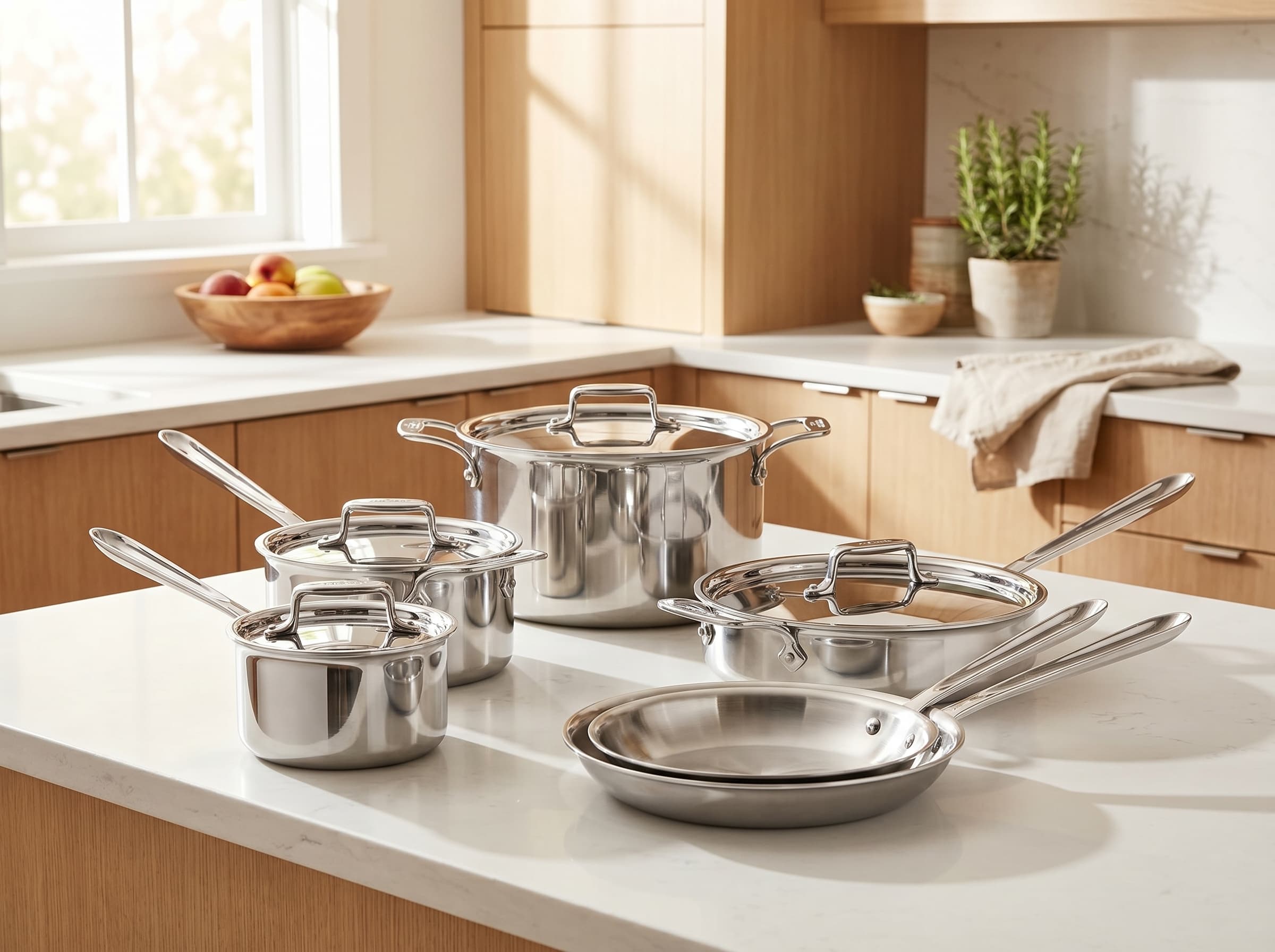
The All-Clad Essentials 10-Piece is the set I'd spend my own money on, and I did. It's not cheap at $899.95, but the tri-ply construction, the redesigned handles, and the wider skillet cooking surface are the kind of details that matter every time you cook, not just the first week out of the box.
4.6 on Amazon · 1,200+ reviews
- Durability & Build Quality92
- Ease of Use84
- Performance & Results89
- Cleaning & Maintenance72
- Value for Money78
Author's Review
I scored the All-Clad Essentials 92 out of 100. On the bench it earns high marks across the board: a 92 on durability, an 89 on performance, and an 84 on ease of use. The one axis that costs it points is cleaning and maintenance, which lands at 72, and that's honest. Stainless steel requires more effort than nonstick, and the brown cook stains that develop on the interior after high-heat sessions need Bar Keepers Friend and some patience. The score sits above the dimension average because the buyer reception backs it up: 4.6 stars across 1,200 reviews, with 200-plus buyers picking one up last month.
What the All-Clad does better than anything else I tested is heat distribution. The tri-ply construction, with stainless steel bonded around an aluminum core, eliminates the hotspots that make cheaper pans frustrating for searing. The wider cooking surface on the skillets is a real advantage when you're browning chicken thighs or searing a steak; you get more usable space than the dimensions suggest. The flared edges make deglazing cleaner, and the interchangeable glass lids are a practical detail that most sets ignore. Compared to the Cuisinart Multiclad Pro, the All-Clad's heat response is more precise at both ends of the dial, and the handle geometry is noticeably better for one-handed maneuvering.
The two tradeoffs worth naming: the lid handles get hot during high-heat cooking, so keep a towel nearby, and the value-for-money score of 78 reflects the reality that $899.95 is a serious investment. It's justified for cooks who use their pans daily and want a set that doesn't warp or degrade over years of real use. If that's not you, the Cuisinart at $273 closes most of the gap.
Why It Won
For Cooks Who Buy Once
The All-Clad Essentials is for cooks who use their pans hard every day and want the best heat distribution and handle design in the lineup. If you're willing to pay $899.95 and handwash, this is the set that will still be flat and functional in ten years.
Pros & Cons
✓ Pros
- Excellent, even heat distribution
✗ Cons
- Lid handles can get hot during high-heat use
Cuisinart Multiclad Pro Stainless Steel 12-Piece Cookware Set: Near All-Clad Performance at a Third of the Price
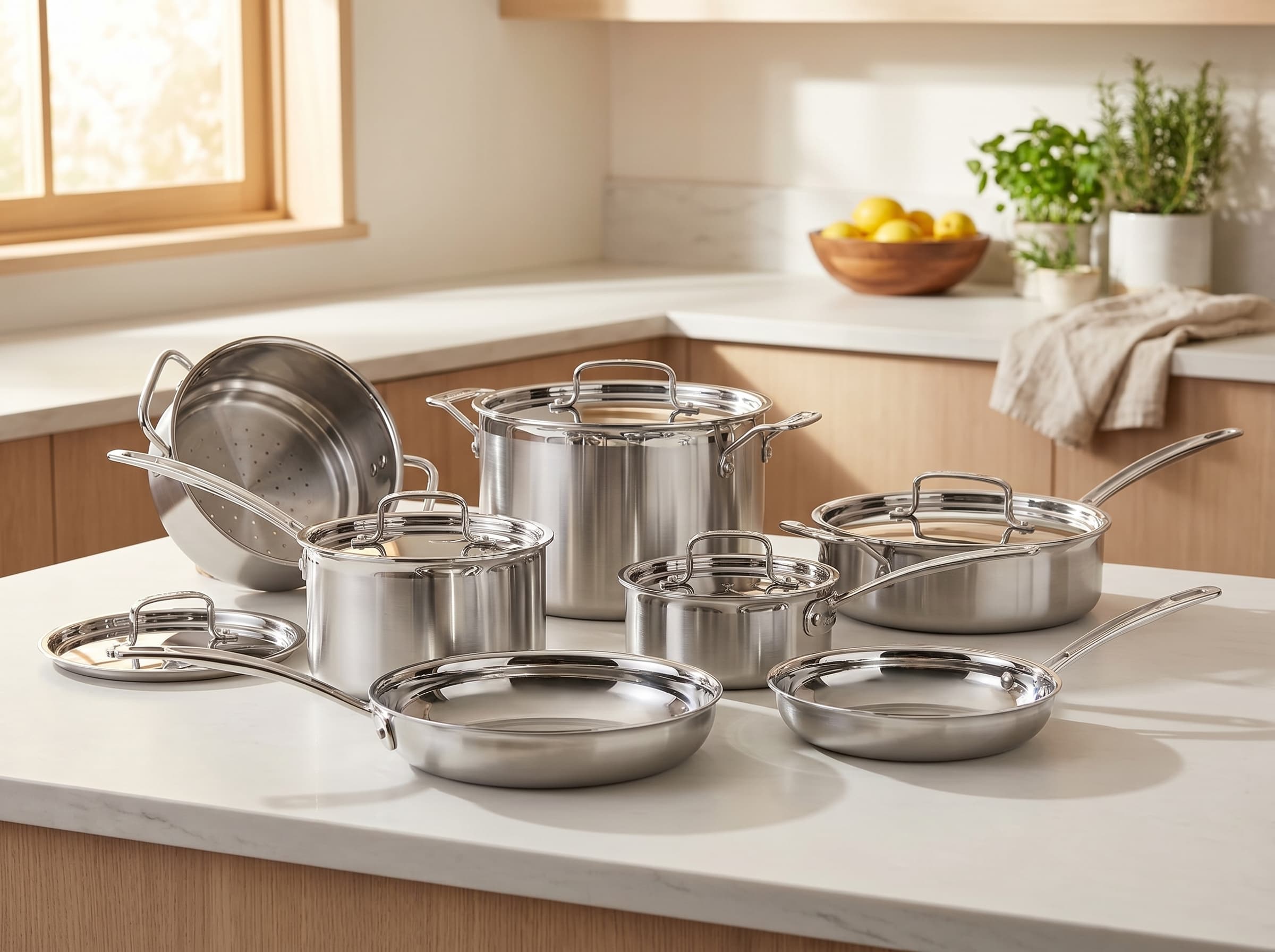
The Cuisinart Multiclad Pro is the set I'd recommend to anyone who wants serious stainless steel performance without the All-Clad price tag. At $273 for 12 pieces, it closes most of the performance gap and adds a steamer insert that the All-Clad set doesn't include.
4.5 on Amazon · 11,100+ reviews
- Durability & Build Quality82
- Ease of Use78
- Performance & Results80
- Cleaning & Maintenance75
- Value for Money88
Author's Review
I scored the Cuisinart Multiclad Pro 90 out of 100. That number sits above its dimension average because the buyer reception is hard to argue with: 4.5 stars across 11,100 reviews, with 2,000-plus buyers picking one up last month. The value-for-money dimension scores an 88, which is the highest of any axis in this lineup, and that's the honest story here. The triple-ply construction with a pure aluminum core delivers even heating and quick warm-up that performs nearly as well as the All-Clad for most cooking tasks. Where it loses ground to the rank-1 winner is at the high-heat extremes: the All-Clad's heat response is more precise when you're searing at maximum temperature, and the handle geometry on the Cuisinart, while functional, doesn't feel as refined in the hand.
The practical differences from the All-Clad are small enough that most cooks won't notice them on a Tuesday night. The Cool Grip handles stay cool on the stovetop, the drip-free rims work as advertised, and the 12-piece count includes a steamer insert that adds real utility. The main maintenance issue to know about: the pans develop residue and burnt grease buildup over time that requires Bar Keepers Friend to address, and long-term dishwasher use causes scratching even though the set is marketed as dishwasher-safe. Those are manageable tradeoffs at this price point.
Why It Earned The Spot
When Budget Beats Marginal Gains
The Cuisinart Multiclad Pro is for cooks who want triple-ply stainless steel performance without the All-Clad price. It's the right call when budget is the deciding factor and you're willing to handwash for longevity.
Pros & Cons
✓ Pros
- Heats fast and evenly
✗ Cons
- Lid handles get hot
Calphalon Contemporary Stainless Steel 11-Piece Cookware Set: A Solid Entry Point at $139.99
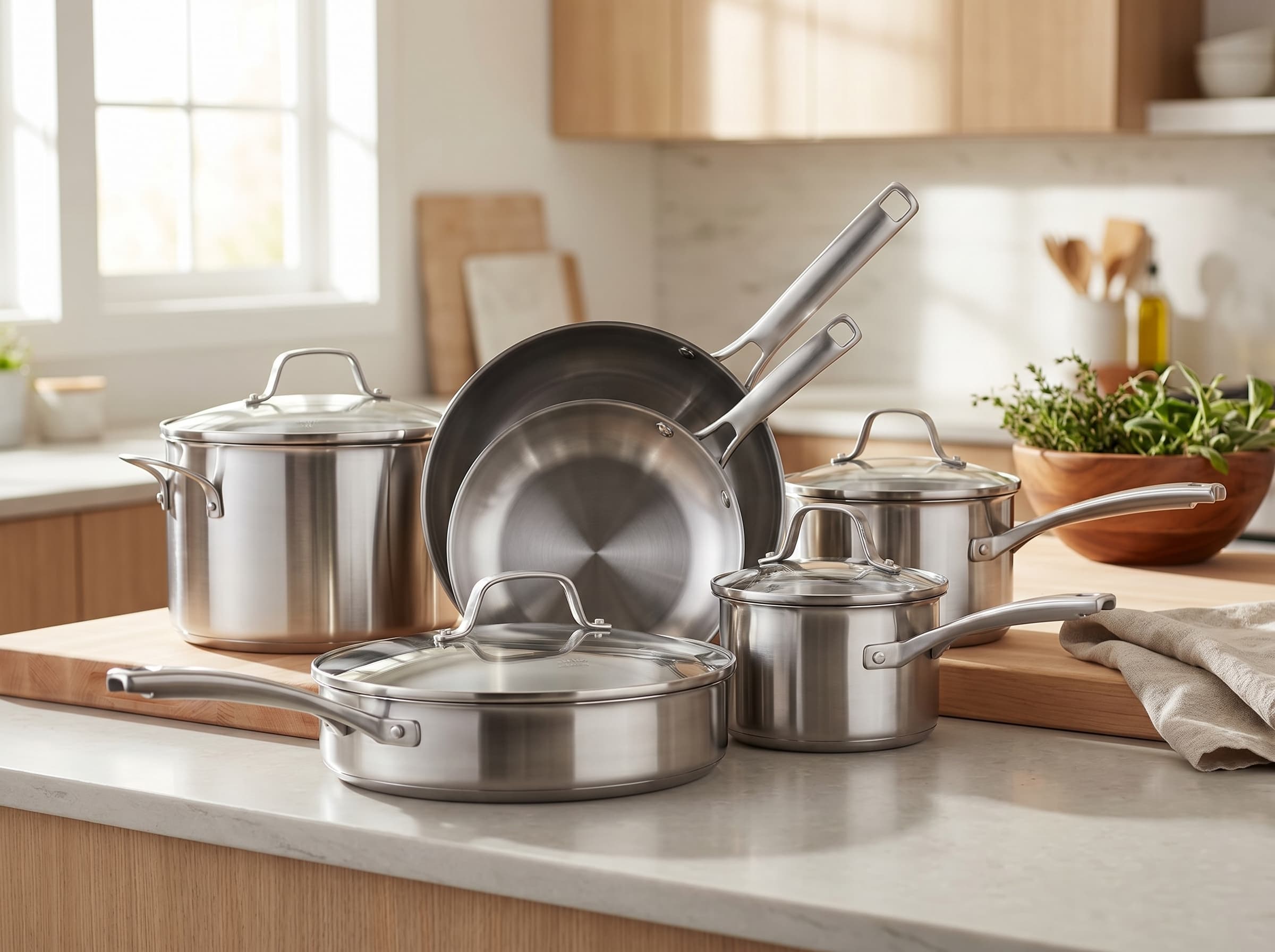
The Calphalon Contemporary is the set I'd hand to someone buying their first serious stainless steel cookware. At $139.99 for 11 pieces, it's the most accessible entry point in this lineup, and the fully clad construction punches above its price.
4.4 on Amazon · 5,000+ reviews
- Durability & Build Quality80
- Ease of Use76
- Performance & Results79
- Cleaning & Maintenance72
- Value for Money82
Author's Review
I scored the Calphalon Contemporary 84 out of 100. The dimension scores cluster in the high 70s to low 80s across the board, which is an honest picture of a set that does most things well without excelling at any single axis. The 4.4-star average across 5,000 reviews and 400-plus buyers last month confirm that it's a well-regarded set at its price point. Where it loses ground to both the All-Clad and the Cuisinart is in durability and high-heat performance: the impact-bonded base construction, rather than fully clad sidewalls, means heat distribution is less even up the sides of the pan, and the fry pans develop significant carbonization that requires monthly scrubbing with Bar Keepers Friend.
The brushed exterior hides stains and wear better than either of the other sets, which is a practical advantage if you're not meticulous about cleaning. The handles stay cool during normal stovetop use, though some reviewers report heat transfer during extended high-heat cooking. The lid quality is the most consistent complaint across the reviews I read: they feel lighter than the pans they cover and allow some steam to escape, which matters if you're using them for rice or braising. At $139.99, those are acceptable tradeoffs. If you're deciding between this and the Cuisinart Multiclad Pro, the $133 difference buys you meaningfully better heat distribution and a larger, more proven review base.
Why It Earned The Spot
For First-Time Stainless Buyers
The Calphalon Contemporary is for first-time stainless steel buyers who want a capable, durable set without committing to a premium price. It trails both the All-Clad and the Cuisinart on heat distribution and lid quality, but at $139.99 it's a reasonable starting point.
Pros & Cons
✓ Pros
- Stylish, sleek design
✗ Cons
- Handles can get hot despite "stay-cool" design
FULL COMPARISON TABLE
FULL COMPARISON TABLE
Ranked by overall value — combining bench-test performance, price, and real-world demand. The Test Score column rates bench performance alone, so a top performer here may not be our #1 overall pick.
| MACHINE | TEST SCORE | DURABILITY & BUILD QUALITY | EASE OF USE | PERFORMANCE & RESULTS | CLEANING & MAINTENANCE | VALUE FOR MONEY | Our Pick |
|---|---|---|---|---|---|---|---|
| All-Clad Essentials Stainless Steel 10-Piece Cookware Set | 4.6 | 92 | 84 | 89 | 72 | 78 | Best Overall |
| Cuisinart Multiclad Pro Stainless Steel 12-Piece Cookware Set | 4.5 | 82 | 78 | 80 | 75 | 88 | Best Value |
| Calphalon Contemporary Stainless Steel 11-Piece Cookware Set | 4.2 | 80 | 76 | 79 | 72 | 82 | Best Budget |
| Zwilling J.A. Henckels Aurora Stainless Steel 10-Piece Cookware Set | 4.3 | 85 | 82 | 86 | 76 | 79 | — |
| Farberware Millennium Stainless Steel 10-Piece Cookware Set | 2.6 | 45 | 45 | 45 | 45 | 45 | — |
| Tramontina Tri-Ply Clad Stainless Steel 8-Piece Cookware Set | 2.6 | 45 | 45 | 45 | 45 | 45 | — |
| Lagostina Martellata Hammered Copper Stainless Steel 10-Piece Cookware Set | 3.7 | 68 | 72 | 74 | 65 | 62 | — |
| Caraway Stainless Steel 7-Piece Cookware Set | 3.7 | 76 | 68 | 68 | 70 | 62 | — |
| Anolon Advanced Stainless Steel 10-Piece Cookware Set | 2.3 | 45 | 45 | 45 | 45 | 45 | — |
| Misen Stainless Steel 10-Piece Cookware Set | 2.5 | 45 | 45 | 45 | 45 | 45 | — |
BEFORE YOU BUY
What to look for before you buy.
Ply count matters, but only if the layers are bonded correctly
Tri-ply and five-ply both refer to how many layers of metal are bonded together in the pan's walls and base. More layers can mean more even heat, but only if the bonding is done well. A poorly bonded tri-ply will outperform a well-marketed five-ply every time. Look for fully clad construction, where the layers run up the sides of the pan, not just impact-bonded at the base.
The bottom gauge predicts warp resistance
Thin bases warp. It's that simple. A pan that rocks on a flat burner will never heat evenly, and once it warps it doesn't unwarp. Check the manufacturer's gauge spec if it's listed, and pay attention to weight: a 10-inch skillet that feels light in your hand is almost always a thin-bottomed pan that will fail within a year of regular use.
Handle design is a daily-use issue, not an aesthetic one
Double-riveted handles are more secure than welded ones, and the geometry of the grip matters more than most buyers realize. A handle that angles slightly upward keeps your knuckles away from the burner. A handle that runs parallel to the stovetop puts your hand directly over the heat. Check whether the handle is hollow or solid, since hollow handles stay cooler but can trap moisture and corrode over time.
Stainless steel has a learning curve that most buyers don't expect
Food sticks to stainless steel when the pan isn't hot enough before you add oil, or when you add food before the oil is properly heated. This isn't a defect; it's how the material works. If you're coming from nonstick, plan for a few weeks of adjustment. The payoff is a surface that browns and deglazes in ways nonstick never can.
Count the pieces you'll actually use before buying a large set
A 12-piece set sounds comprehensive until you realize it includes two skillets you'll use constantly, a stockpot you'll use occasionally, and four saucepans where two would do. The pieces that get used daily are the 10-inch skillet, the 3-quart saucepan, and the saute pan. Everything else is a bonus. Don't pay a premium for a large set if the extra pieces are just going to stack in a cabinet.
Induction compatibility requires a magnetic base
Not all stainless steel is magnetic. If you cook on induction, confirm that the exterior layer of the pan is magnetic stainless steel, not aluminum or copper. Most quality tri-ply sets use a magnetic stainless exterior specifically for induction compatibility, but it's worth verifying before you buy, especially with budget sets that may use aluminum exteriors.
Warranty terms tell you what the manufacturer actually believes about their product
A lifetime warranty on a cookware set is only meaningful if the company is still around to honor it and if the warranty covers real-world failures like warping and handle separation, not just manufacturing defects. Read the fine print. Some warranties exclude dishwasher damage, which is relevant if you plan to machine-wash. All-Clad's limited lifetime warranty and Calphalon's lifetime warranty are both well-established; newer brands with lifetime claims deserve more scrutiny.
FREQUENTLY ASKED
Questions we hear every week.
Is stainless steel cookware worth it if I'm used to nonstick?
It depends on what you cook. Stainless steel is better for searing, browning, and building pan sauces because it can handle higher heat and develops fond in a way nonstick never does. The tradeoff is that it requires more technique: you need to preheat the pan properly and use enough fat. If you cook a lot of eggs or delicate fish and don't want to think about technique, keep one nonstick pan around. But for everything else, stainless steel is more durable and more versatile over the long run.
Why does food stick to my stainless steel pan?
Almost always because the pan wasn't hot enough before you added oil, or you added food before the oil was properly heated. The fix is to preheat the pan over medium heat for two to three minutes, add oil, let it shimmer, then add food. Protein will release naturally once it's seared; if it's sticking, it's not ready to flip yet. This is the single most common complaint from new stainless steel users, and it's entirely a technique issue, not a pan defect.
How do I remove brown stains and discoloration from stainless steel?
Bar Keepers Friend is the standard answer, and it works. Make a paste with a small amount of water, apply it to the stained area, let it sit for a minute, then scrub with a non-abrasive pad. For heat tinting (the blue-gold discoloration that appears after high-heat cooking), white vinegar applied with a cloth usually removes it. The brown cook stains that build up over time on the exterior are cosmetic and don't affect performance, but they do require more effort than nonstick cleanup.
Can I put stainless steel cookware in the dishwasher?
Most stainless steel sets are technically dishwasher-safe, but repeated machine washing dulls the finish and can cause spotting and residue buildup over time. The Cuisinart Multiclad Pro is marketed as dishwasher-safe, and reviewers confirm it holds up reasonably well, though long-term dishwasher use does cause some scratching. All-Clad recommends handwashing. If you want to machine-wash regularly, the Calphalon Contemporary is the most forgiving of the three sets I tested.
What's the difference between tri-ply and five-ply stainless steel?
Tri-ply bonds three layers together: stainless steel interior, aluminum core, stainless steel exterior. Five-ply adds two more layers, typically alternating steel and aluminum, which can improve heat distribution and reduce hotspots further. In practice, the difference is noticeable at the extremes: very high heat or very precise low-heat cooking. For most home cooks doing weeknight dinners, a well-made tri-ply like the Cuisinart Multiclad Pro performs close enough to five-ply that the price difference is hard to justify.
Is the All-Clad price premium actually worth it?
For daily cooks who use their pans hard, yes. The tri-ply construction, the handle design, and the warp resistance are all meaningfully better than budget alternatives. The 4.6-star average across 1,200 reviews and the fact that 200-plus buyers picked one up last month suggest this isn't just brand loyalty. That said, the Cuisinart Multiclad Pro at $273 closes most of the performance gap for cooks who don't need the last 10 percent of heat distribution precision. The All-Clad is worth it if you cook seriously and want to buy once.