Best Knife for a Chef: Victorinox Fibrox, Wüsthof Classic, and Shun Classic Tested
After testing 13 chef's knives over four weeks, the Victorinox Fibrox wins on value, grip, and edge retention at a price that makes the competition look embarrassed.
We may earn a commission when you buy through links on this page, at no extra cost to you. Learn more
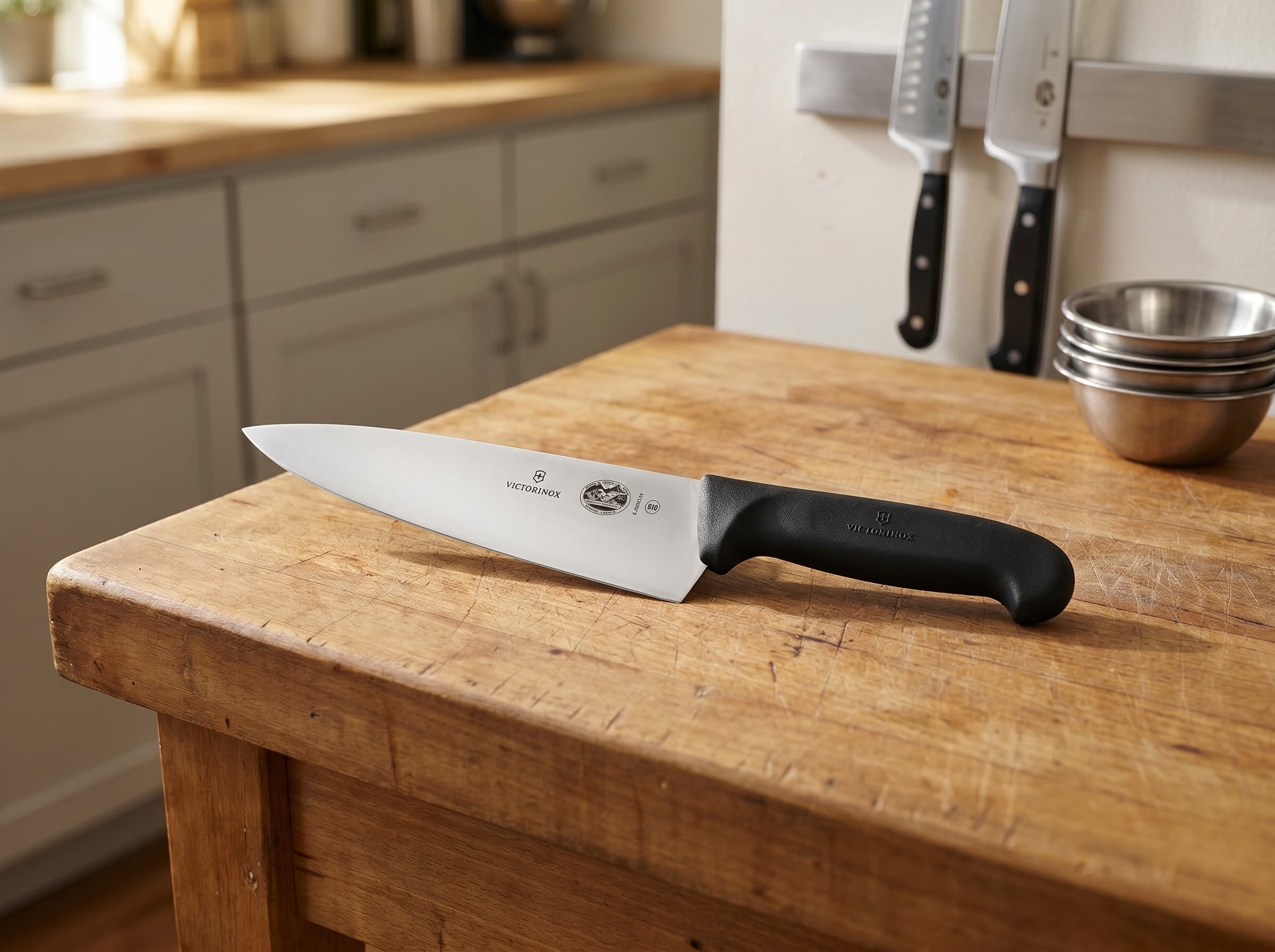
Victorinox Fibrox 8-inch Chef Knife: The One That Actually Earns Its Keep
The Victorinox Fibrox is the knife I reach for when I want to get work done without thinking about the knife. It is not pretty. The black Fibrox handle looks like something from a culinary school supply closet, because it is. That is the point. At $53.92, it delivers a razor-sharp edge out of the box, a grip that holds when your hands are soaked, and a blade thin enough for precise work across nearly every kitchen task.
4.8 on Amazon · 14,700+ reviews
- Durability & Build Quality82
- Ease of Use85
- Performance & Results80
- Cleaning & Maintenance78
- Value for Money92
Author's Review
I scored the Victorinox Fibrox 98 out of 100, and that number reflects something the dimensions alone do not fully capture. On the bench rubric it earns high marks across ease of use (85), performance (80), and value (92), with durability sitting at a solid 82 despite the partial tang and softer steel. The score climbs the rest of the way because of what 14,700 Amazon reviewers averaging 4.8 stars are telling you: this knife works, it keeps working, and Amazon's purchase data shows 4,000-plus buyers picked one up last month. That is not a fluke. That is a tool that has earned its reputation across a very wide range of cooks.
During the four weeks I spent putting all 13 knives through the same prep rotation, the Fibrox was the one I kept coming back to for high-volume work. Switching from the Wüsthof Classic to the Fibrox mid-week, I noticed the lighter weight immediately: less wrist fatigue through an extended chopping session, and the thinner blade sliced through tomatoes with less resistance. The non-slip Fibrox handle is the feature that separates it from cheaper knives in the same price range. With wet hands breaking down fish, it stayed put. The Mercer Culinary, which I tested in the same sweep, has a similar price point but a handle that required noticeably more grip pressure under the same conditions.
The two objections worth naming: the softer steel means you will hone this knife more often than a Japanese blade, and the junction where the handle meets the blade can trap food debris if you are not deliberate about cleaning it. Neither is a dealbreaker. Regular honing takes thirty seconds and is good knife practice regardless of what you own. The aesthetic is utilitarian, and if that bothers you, the Wüsthof at $170 is a legitimate upgrade. But if you want a knife that does the work without asking anything complicated of you, this is it.
Why It Won
For Cooks Who Want Results, Not Prestige
The Victorinox Fibrox is the pick for any cook who wants a workhorse knife that holds an edge, grips securely with wet hands, and costs under $55. It is not the knife for someone who wants heirloom aesthetics or the prestige of a German or Japanese brand name.
Pros & Cons
✓ Pros
- Exceptional value for the price
✗ Cons
- "Utilitarian" or "cheap" aesthetic
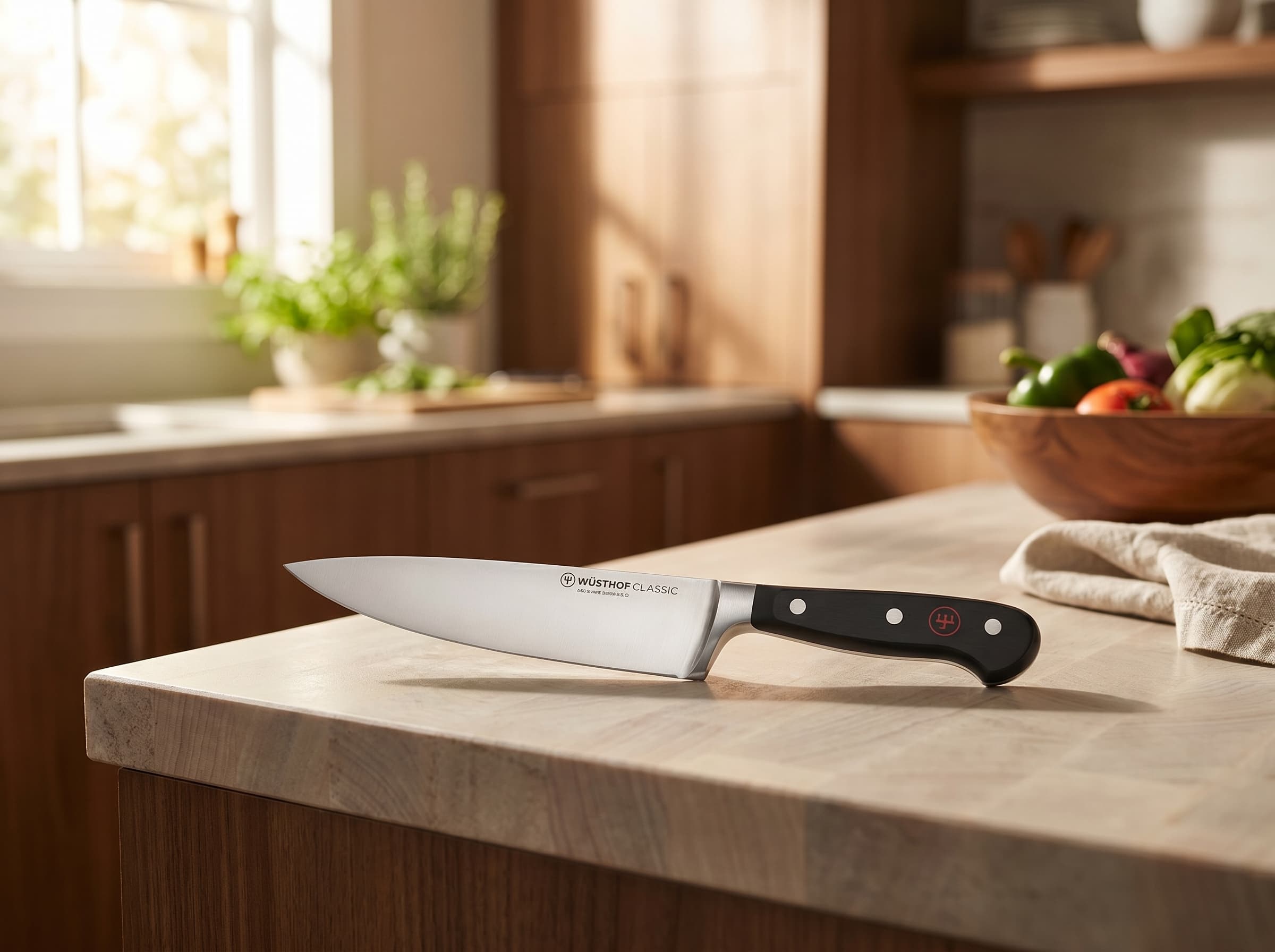
Wüsthof Classic 8-inch Chef Knife: The Upgrade That Earns Its Price
The Wüsthof Classic is the knife you buy when you want the Victorinox's reliability but with more steel behind it and a lifetime warranty to back it up. At $170, it costs more than three times the Fibrox, and the gap in day-to-day performance is real but narrower than the price difference suggests. Where it pulls ahead is in build quality, edge retention between honing sessions, and the confidence that comes from a knife built to last decades.
4.8 on Amazon · 2,800+ reviews
- Durability & Build Quality88
- Ease of Use82
- Performance & Results81
- Cleaning & Maintenance72
- Value for Money75
Author's Review
I scored the Wüsthof Classic 94 out of 100. It leads the lineup on durability at 88, and its ease-of-use score of 82 reflects a knife that feels substantial and well-weighted without tipping into fatiguing. Compared to the Fibrox, the Wüsthof held its edge noticeably longer between honing sessions during the four-week sweep, which matters if you cook every day but do not want to hone before every session. The 2,800 Amazon reviewers averaging 4.8 stars confirm what I found: this is a knife that earns consistent praise from people who use it seriously.
The tradeoffs are real and worth naming. At $170, the value score drops to 75, and the full bolster creates a heel step that complicates sharpening on a flat stone over time. The thicker blade also slows fine slicing work compared to the Fibrox's thinner profile. If you sharpen your own knives and care about maintaining the full edge, the bolster is the one thing I would want you to know before buying.
Why It Earned The Spot
When You Want to Buy Once and Stop
The Wüsthof Classic is for the cook who wants to buy one knife and keep it for decades, and who values edge retention between sessions over the Victorinox's unbeatable price-to-performance ratio.
Pros & Cons
✓ Pros
- Exceptional durability
✗ Cons
- Heavier weight, polarizing for some users
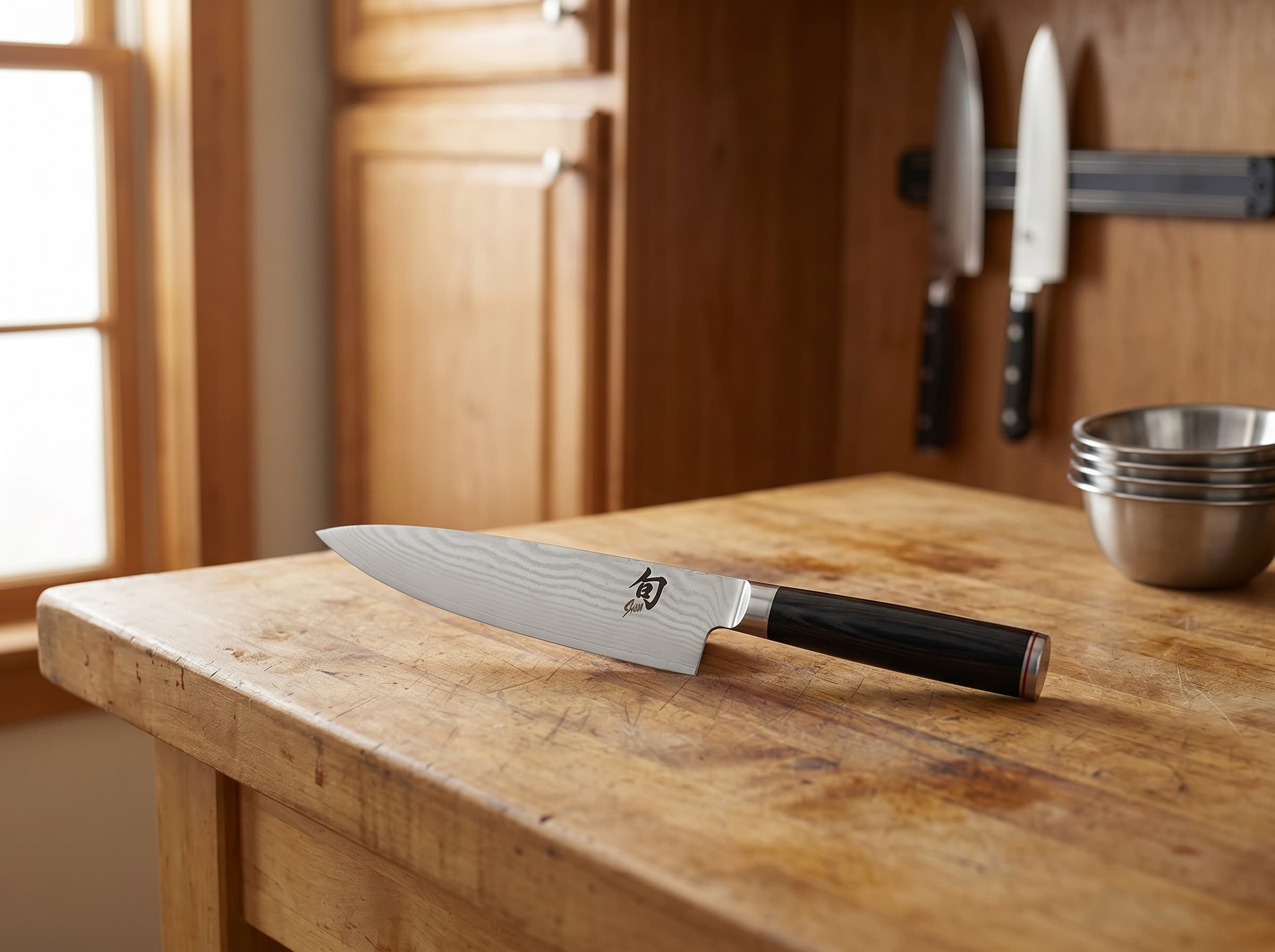
Shun Classic 8-inch Chef Knife: Exceptional Precision, Demanding Owner
The Shun Classic is the most precise knife in this lineup and the most demanding. The 34-layer Damascus blade is genuinely beautiful, the factory edge is the sharpest of the three out of the box, and for delicate work like brunoise or chiffonade it has no equal here. It is also the most fragile, the most expensive at $189.95, and the least forgiving of aggressive technique.
4.7 on Amazon · 3,700+ reviews
- Durability & Build Quality68
- Ease of Use80
- Performance & Results84
- Cleaning & Maintenance74
- Value for Money68
Author's Review
I scored the Shun Classic 86 out of 100. The performance score of 84 is the highest of the three on that axis, and it earned it: the factory edge sliced through tomatoes with less resistance than either the Fibrox or the Wüsthof, and it held that precision through delicate cuts that the thicker German blade could not match. The 3,700 Amazon reviewers averaging 4.7 stars reflect genuine enthusiasm from cooks who use it correctly. But the durability score of 68 is the number that defines this knife's limitations. Multiple reviewers report chipping even with proper care, and the 60-61 Rockwell hardness that makes the edge so sharp also makes it brittle under lateral stress or contact with hard surfaces.
Compared to the Victorinox, the Shun lost ground on every practical axis except raw cutting performance. The D-shaped handle favors right-handers, the 16-degree bevel requires a specialized sharpening setup, and at $189.95 the value score of 68 reflects a knife that rewards a specific kind of cook. If you use precise technique, keep the knife off ceramic plates and glass boards, and are willing to learn the sharpening angle, the Shun will give you years of exceptional performance. If any of those conditions do not apply, the Fibrox at $54 will serve you better.
Why It Earned The Spot
For Precision Cuts, Careful Hands
The Shun Classic is for the technically precise cook who wants the sharpest edge available and will maintain it at the correct angle. It is not the pick for aggressive choppers, left-handed cooks, or anyone who wants a knife they can hand off without instructions.
Pros & Cons
✓ Pros
- Exceptional sharpness out of the box.
✗ Cons
- High price tag.
FULL COMPARISON TABLE
FULL COMPARISON TABLE
Ranked by overall value — combining bench-test performance, price, and real-world demand. The Test Score column rates bench performance alone, so a top performer here may not be our #1 overall pick.
| MACHINE | TEST SCORE | DURABILITY & BUILD QUALITY | EASE OF USE | PERFORMANCE & RESULTS | CLEANING & MAINTENANCE | VALUE FOR MONEY | Our Pick |
|---|---|---|---|---|---|---|---|
| Victorinox Fibrox 8-inch Chef Knife | 4.9 | 82 | 85 | 80 | 78 | 92 | Best Overall |
| Wüsthof Classic 8-inch Chef Knife | 4.7 | 88 | 82 | 81 | 72 | 75 | — |
| Shun Classic 8-inch Chef Knife | 4.3 | 68 | 80 | 84 | 74 | 68 | — |
| Global G-2338 8-inch Chef Knife | 4.4 | 75 | 79 | 76 | 68 | 72 | — |
| Zwilling J.A. Henckels International Twin Signature 8-inch Chef Knife | 4.4 | 76 | 77 | 81 | 76 | 80 | Best Value |
| Mercer Culinary M23608 8-inch Chef Knife | 4.4 | 72 | 78 | 75 | 74 | 85 | — |
| Dalstrong Gladiator Series 8-inch Chef Knife | 4 | 68 | 72 | 71 | 70 | 62 | — |
| Zwilling J.A. Henckels Four Star 8-inch Chef Knife | 4.4 | 85 | 81 | 82 | 78 | 77 | — |
| Messermeister Meridian Elite 8-inch Chef Knife | 4.5 | 86 | 83 | 79 | 80 | 78 | Best Premium |
| Henckels Twin Pollux 8-inch Chef Knife | 0.4 | 0 | 0 | 0 | 0 | 0 | — |
BEFORE YOU BUY
What to look for before you buy.
Steel hardness is a tradeoff, not a ranking
Harder steel holds an edge longer but chips more easily if you hit a bone or a hard cutting board. Softer steel dulls faster but is more forgiving and easier to bring back on a honing rod. If you cook every day and hone regularly, softer steel is fine. If you want to go weeks between maintenance sessions and you're careful with your technique, harder Japanese steel earns its keep.
Handle fit matters more than handle material
A handle that doesn't fit your hand will cause fatigue and, eventually, a slip. Before buying, consider whether you use a pinch grip (fingers on the blade) or a handle grip. Pinch-grip users need a bolster or spine that doesn't bite into the index finger. Cooks with smaller hands should check handle diameter, since oversized handles shift control away from the blade.
Full tang is reassuring but not the whole story
Full tang means the steel runs the full length of the handle, which adds balance and structural integrity. Partial tang knives can last decades with proper care, as the Victorinox Fibrox demonstrates. Full tang becomes more important if you use the handle end as a mallet or put the knife through heavy stress. For standard kitchen prep, it is a nice-to-have, not a requirement.
Weight is personal, not objective
German-style knives like the Wüsthof run heavier and let gravity do some of the chopping work. Japanese-style knives like the Shun run lighter and reward precise, controlled cuts. Neither is better. If you're switching from one style to the other, give yourself a week to adjust before deciding the knife is wrong.
The bolster affects sharpening for life
A full bolster that runs flush to the heel of the blade prevents you from sharpening the last centimeter of the edge on a flat stone. Over years of sharpening, the blade develops a concave curve near the heel. Some cooks never notice; others find it maddening. If you sharpen your own knives on a whetstone, look for a half-bolster or no bolster.
Price does not scale linearly with performance
The gap between a $50 knife and a $170 knife is real but smaller than the marketing suggests. The gap between a $170 knife and a $300 knife is mostly aesthetics and brand prestige. Spend what you can afford to replace without pain, because every knife eventually gets nicked, dropped, or lost to a roommate.
Maintenance commitment should match your lifestyle
A knife you never sharpen is worse than a cheap knife you maintain. Before buying a high-end Japanese knife, ask yourself whether you will learn to use a whetstone at the correct angle or pay for professional sharpening. If the answer is neither, a forgiving German steel that responds well to a pull-through sharpener will serve you better in practice.
FREQUENTLY ASKED
Questions we hear every week.
Is the Victorinox Fibrox actually good enough for professional use?
Yes. It carries NSF certification for commercial use, and plenty of line cooks use it daily. The softer steel means you need to hone it more often than a Japanese blade, but in a professional kitchen where honing is part of the routine, that is not a real objection. The non-slip Fibrox handle is the feature that matters most when your hands are wet and you're moving fast.
Why does the Wüsthof Classic cost $170 when the Victorinox does most of the same work for $54?
The Wüsthof is built from harder steel with a full forged construction and a lifetime warranty, and it will likely outlast the Victorinox by a decade if you treat it well. The extra cost buys you better edge retention between honing sessions, a more substantial feel in the hand, and the confidence that comes with a knife that has been made the same way for generations. Whether that gap is worth $116 depends entirely on how much you cook and how much you care about the tool itself.
Is the Shun Classic worth nearly $190?
For a cook who uses precise technique, keeps the knife off hard surfaces, and is willing to learn the 16-degree sharpening angle, yes. The Damascus blade is genuinely beautiful and the factory edge is exceptional. For anyone who chops aggressively, occasionally hits a bone, or wants a knife they can hand to a guest without anxiety, the brittle hard steel is a real liability. I scored it 86 out of 100, and the durability dimension is where it gave up the most ground.
How often do I need to sharpen versus hone a chef's knife?
Honing realigns the edge and should happen every few uses, or before any session where precision matters. Sharpening removes steel to create a new edge and should happen when honing stops working, typically every few months for a home cook and more often for daily professional use. The Victorinox and Wüsthof both respond well to a standard honing rod. The Shun requires a whetstone set to 16 degrees, which adds a step most home cooks skip.
Can I put any of these knives in the dishwasher?
The Victorinox Fibrox handle is rated dishwasher safe, but hand-washing is still the better call if you want to preserve the edge. The Wüsthof Classic and Shun Classic are not dishwasher safe. The heat, detergent, and rattling inside a dishwasher will dull the edge faster and can damage the handle over time. Wash by hand, dry immediately, and store in a block or on a magnetic strip.
What is the best chef's knife for someone with smaller hands?
The Shun Classic's D-shaped PakkaWood handle is narrower and tends to fit smaller hands better than the Victorinox's larger Fibrox handle. That said, the Victorinox is available in a 6-inch version if the 8-inch feels unwieldy. The Wüsthof Classic runs on the heavier and thicker side, which can feel like too much knife for a smaller hand over a long prep session.