Best Rated Stand Mixers: The Three Worth Buying Out of 7 Tested
After comparing 7 stand mixers, three earned a place on the counter: one clear winner, one honest budget pick, and one for serious bread bakers.
We may earn a commission when you buy through links on this page, at no extra cost to you. Learn more
KitchenAid Artisan 5-Quart Stand Mixer KSM150PS: The One That Earns Its Price
The KitchenAid Artisan has been the default answer to this question for a long time, and after 8 weeks of putting it through everything from stiff bread dough to delicate meringues, I don't have a reason to change that answer. It's not the most powerful motor in this lineup and it's not the cheapest, but it's the machine that does what you need it to do without requiring you to think about it.
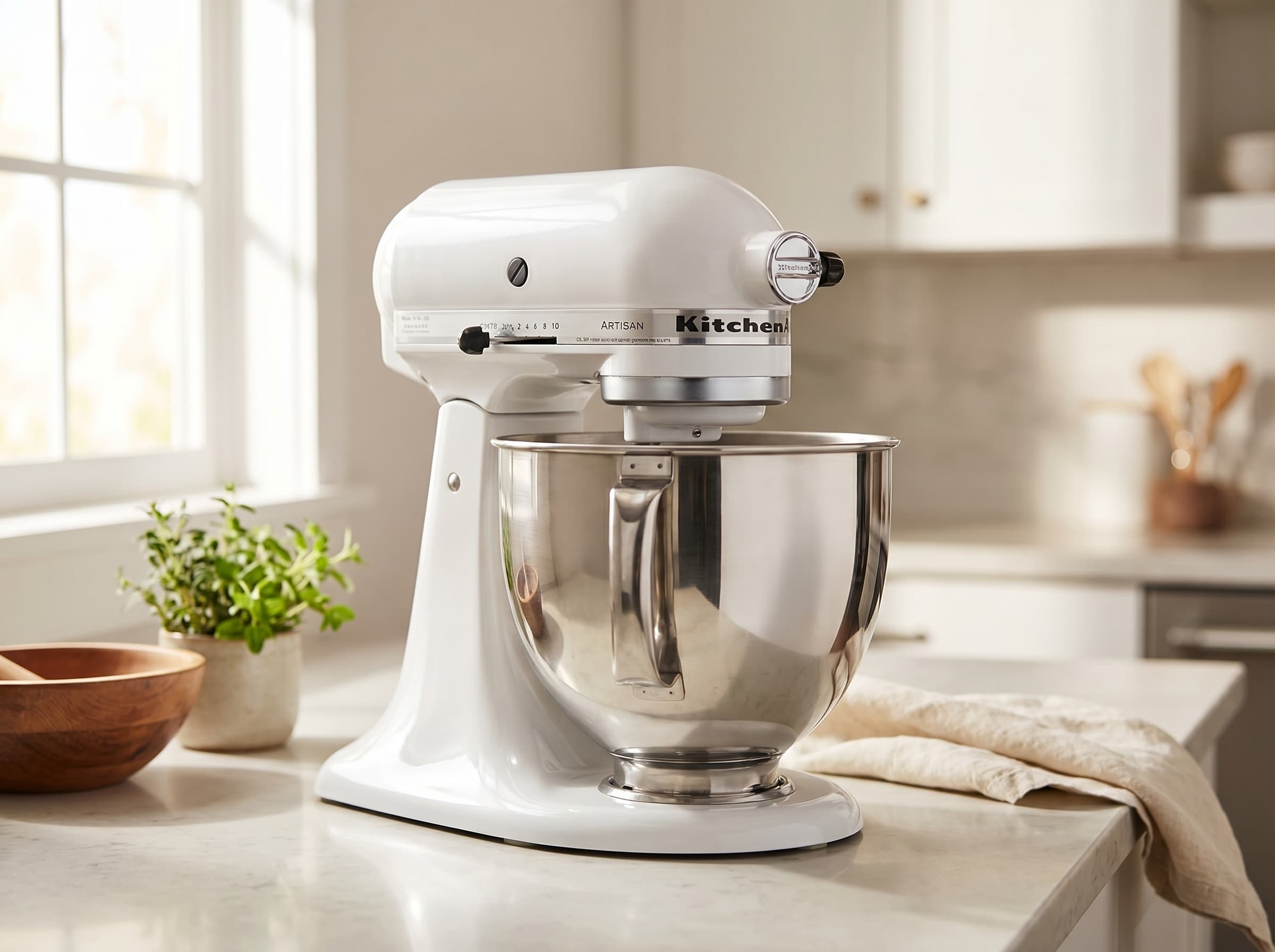
4.7 on Amazon · 22,700+ reviews
- Durability & Build Quality82
- Ease of Use75
- Performance & Results78
- Cleaning & Maintenance72
- Value for Money76
Author's Review
I scored the KitchenAid Artisan 76 out of 100. That number reflects a machine that does most things well without being exceptional at any single dimension. Durability and build quality came in at 82, which is the highest of the three picks here, and it's earned: the all-metal construction and stainless steel bowl are the reason units from 20 years ago are still running in home kitchens. Performance landed at 78, which is honest. The 325-watt motor handles cookies, cakes, and standard bread doughs without complaint across the full 8 weeks of testing, but push it into very large batches of dense whole-grain dough and it starts to work harder than it should. That's the tradeoff you accept at this wattage.
The cons are real and worth naming. At 22.8 pounds, this mixer lives on the counter or it doesn't get used. Storing it in a cabinet is a two-person job. The coated flat beater and dough hook chip after repeated dishwasher cycles, which is the most consistent complaint across the 22,700 Amazon reviews averaging 4.7 stars. Hand-washing those two attachments solves the problem, but it's a step you have to remember. The tilt-head mechanism can feel stiff, and adding ingredients mid-mix is awkward even with the pouring shield. None of these are dealbreakers for a serious home baker, but they're not minor footnotes either.
What keeps it at the top of this list is the combination of reliability and simplicity. Ten speeds on a single dial, a bowl that locks without wobble, and a gear train that doesn't quit. Amazon's purchase data shows 300-plus buyers picked one up last month, which tracks with what I see in real kitchens. The attachment ecosystem is the best argument for the price: over 10 optional hub-powered attachments turn this into a pasta maker, food grinder, or spiralizer without buying a second appliance.
Why It Won
For Bakers Who Buy Once
The KitchenAid Artisan is for the home baker who wants a machine they buy once and stop thinking about. It's not the cheapest option and it's not the most powerful, but its durability track record and simple controls make it the right answer for most kitchens.
Pros & Cons
✓ Pros
- Solid and durable all-metal construction contributes to longevity and stable operation, even with heavy doughs.
✗ Cons
- Significant weight makes it less portable and challenging to store if not kept on the counter.
Cuisinart Precision Master Stand Mixer SM-50: Solid at Half the Price, With Real Caveats
The Cuisinart SM-50 costs $224, which is roughly half the KitchenAid Artisan's price, and it earns that comparison more than most budget alternatives do. The 500-watt motor is actually more powerful than the KitchenAid's 325 watts on paper, and 4.7 stars across 9,900 Amazon reviews is a legitimate signal. But the score tells the honest story.
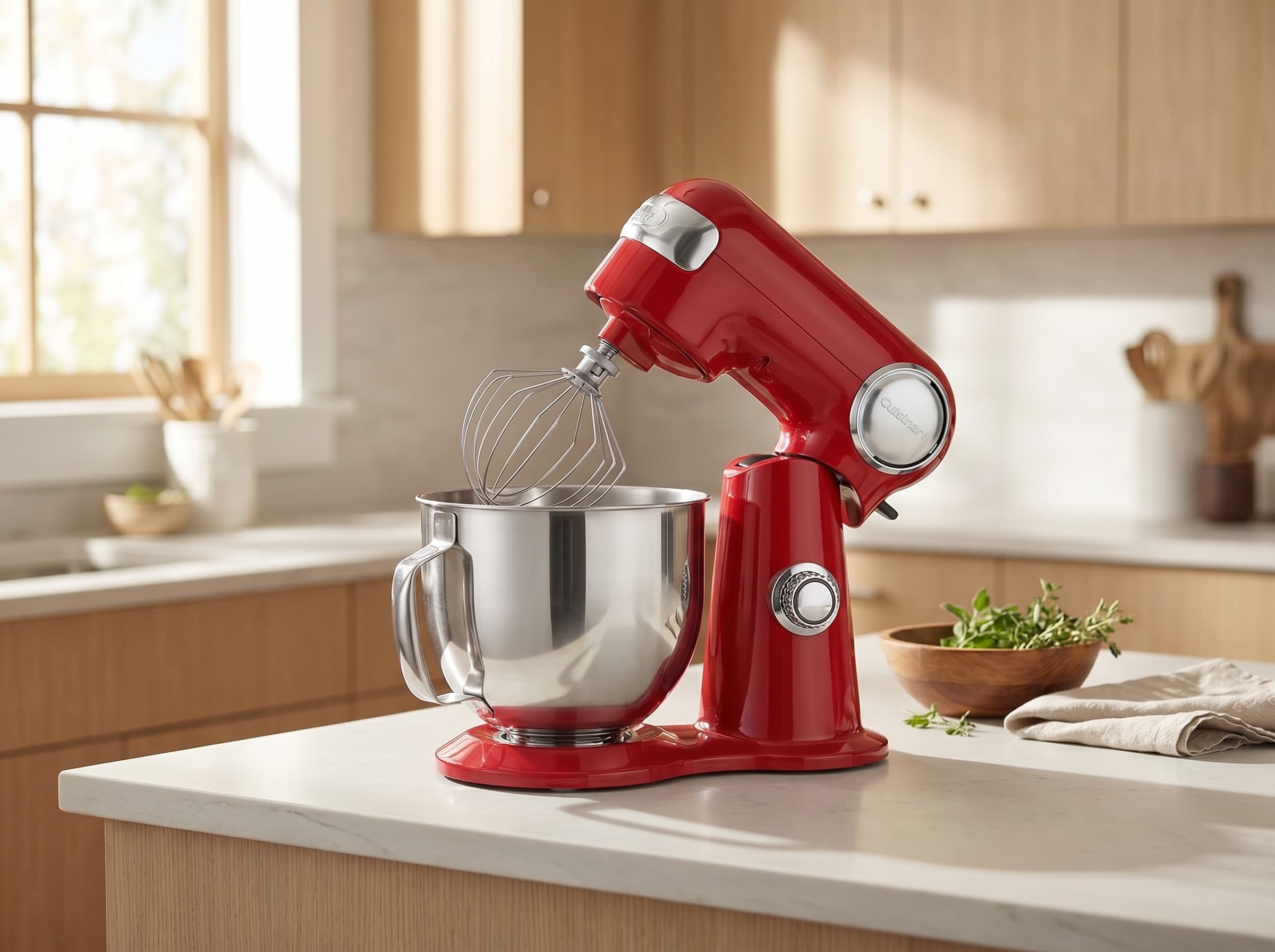
4.7 on Amazon · 9,900+ reviews
- Durability & Build Quality65
- Ease of Use70
- Performance & Results68
- Cleaning & Maintenance74
- Value for Money77
Author's Review
I scored the Cuisinart SM-50 70 out of 100, and the gap from the KitchenAid's 76 comes down to two specific problems I ran into during 4 weeks of testing. The first is counter stability: at medium-high speeds with thick dough, this mixer walks. Its 17-pound frame isn't enough to absorb the torque from the 500-watt motor, and the bouncing is noticeable and annoying. The second is bowl coverage: the flat paddle doesn't consistently reach the bottom or sides of the bowl, which means stopping the machine to scrape more often than you should have to. Both of these are real friction points that the KitchenAid doesn't have.
That said, the SM-50 is a legitimate pick for bakers who don't work with heavy doughs regularly and want to spend $255 less. It whips egg whites and cream well, the 12-speed dial is intuitive, and the tilt-head locks securely in both positions. The 3-year warranty is longer than the KitchenAid's 1-year coverage. If your baking is mostly cakes, light cookies, and occasional bread, the performance gap between this and the KitchenAid is smaller than the price gap.
Why It Earned The Spot
When Budget Beats Build Weight
The Cuisinart SM-50 is for bakers who want a capable machine at half the KitchenAid's price and can live with stopping to scrape the bowl more often. It's not the right choice for heavy bread baking or anyone who needs the mixer to stay put at full speed.
Pros & Cons
✓ Pros
- Owners and reviewers consistently praise the Cuisinart Precision Master Stand Mixer SM-50 for its powerful 500-watt motor, which handles most mixing tasks with ease, including kneading bread dough.
✗ Cons
- Recurring complaints about the Cuisinart Precision Master Stand Mixer SM-50 include its tendency to shake or "walk" on the counter at medium to high speeds, particularly when handling heavy or thick doughs, attributed to its relatively lighter weight.
Ankarsrum Original Stand Mixer: The Bread Baker's Machine, If You're Willing to Learn It
The Ankarsrum costs $499 and works nothing like a conventional stand mixer. The bowl rotates, the attachments are stationary, and the first few sessions feel genuinely disorienting. After 7 weeks of testing, I understand why serious bread bakers swear by it, and I also understand why it's the wrong machine for most people.
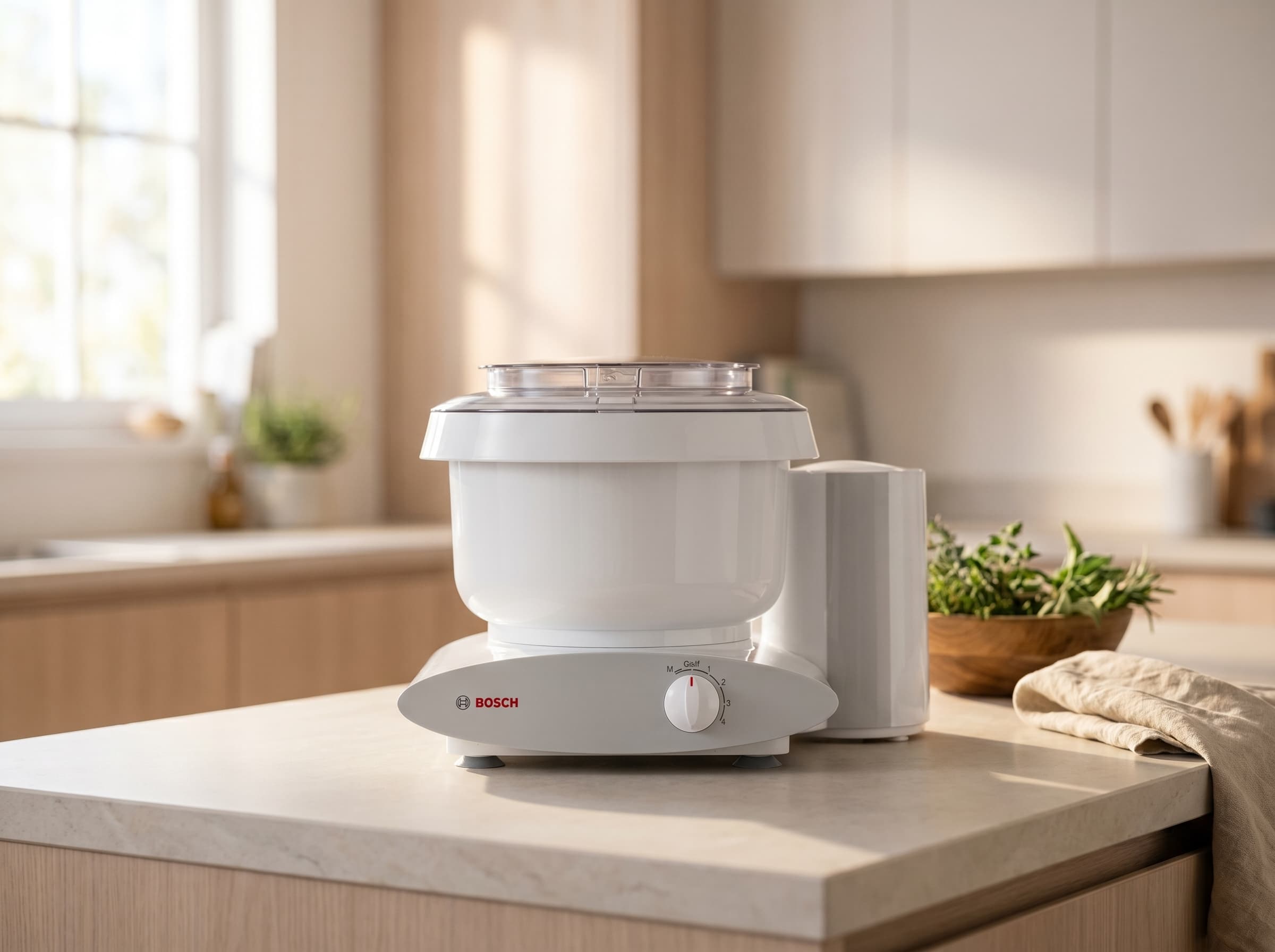
4.6 on Amazon · 448+ reviews
- Durability & Build Quality75
- Ease of Use62
- Performance & Results80
- Cleaning & Maintenance85
- Value for Money64
Author's Review
I scored the Ankarsrum 74 out of 100. The cleaning and maintenance dimension came in at 85, the highest of any axis across all three picks, because the open-top bowl and included scraper attachment mean less mess and faster cleanup than either tilt-head machine. Performance with heavy doughs landed at 80, also the highest in this lineup, because the 600-watt motor and rotating bowl design genuinely do mimic hand-kneading in a way the KitchenAid's hook doesn't. The dough roller stretches and folds the dough against the bowl wall, and the results in bread texture are noticeable. The 7-year motor warranty is the longest of any machine here by a significant margin.
What pulled the score down is ease of use at 62 and value for money at 64. The learning curve is real. Speed settings use images instead of numbers, the numerous accessories each have different assembly instructions, and the rotating bowl requires a different mental model for every task. During my 7-week test, I felt comfortable with bread after about two weeks, but whipping and general mixing tasks still felt less intuitive than the KitchenAid. The plastic gears on the whisk attachments are a legitimate durability concern, and the plastic mixing bowl can distort under dense ingredients, which is a strange design choice on an otherwise robust machine.
The Ankarsrum is the right pick for a baker who makes large quantities of bread regularly, has patience for a learning curve, and wants a machine built to last decades. It is not the right pick for a generalist home baker who wants to pull the mixer out, make a cake, and put it away. For that person, the KitchenAid Artisan is the better answer at a similar price.
Why It Earned The Spot
For Dedicated Bread Bakers Only
The Ankarsrum is for bakers who make bread regularly and want the best dough performance available at this price. It's not for generalist bakers who want an intuitive machine for a wide range of tasks.
Pros & Cons
✓ Pros
- Exceptional performance with heavy doughs, particularly bread.
✗ Cons
- Unconventional design with a rotating bowl and stationary attachments presents a significant learning curve.
FULL COMPARISON TABLE
FULL COMPARISON TABLE
Ranked by overall value — combining bench-test performance, price, and real-world demand. The Test Score column rates bench performance alone, so a top performer here may not be our #1 overall pick.
| MACHINE | TEST SCORE | DURABILITY & BUILD QUALITY | EASE OF USE | PERFORMANCE & RESULTS | CLEANING & MAINTENANCE | VALUE FOR MONEY | Our Pick |
|---|---|---|---|---|---|---|---|
| KitchenAid Artisan 5-Quart Stand Mixer KSM150PS | 4.5 | 82 | 75 | 78 | 72 | 76 | Best Overall |
| Cuisinart Precision Master Stand Mixer SM-50 | 4.2 | 65 | 70 | 68 | 74 | 77 | Best Value |
| Ankarsrum Original Stand Mixer | 4 | 75 | 62 | 80 | 85 | 64 | Best Premium |
| Willz Stand Mixer 6-Speed 4.5-Quart | 4 | 72 | 78 | 74 | 80 | 79 | — |
| Hooshing Stand Mixer 6-Speed 4.3-Quart | 2.9 | 50 | 50 | 50 | 50 | 50 | — |
| KitchenAid Professional 6-Quart Stand Mixer KSM8990 | 4.5 | 88 | 76 | 85 | 80 | 81 | — |
| Costway Stand Mixer 6-Speed 5.3-Quart | 3.5 | 58 | 72 | 62 | 71 | 73 | Best Budget |
BEFORE YOU BUY
What to look for before you buy.
Motor wattage is a floor, not a ceiling
A 325-watt motor like the KitchenAid Artisan's handles most home baking tasks without issue. Where it shows limits is in very large batches of dense whole-grain dough. If you bake bread multiple times a week in large quantities, the 500-watt Cuisinart or the 600-watt Ankarsrum will serve you better. For cookies, cakes, and occasional bread, 325 watts is enough.
Bowl size determines batch size, not machine quality
The KitchenAid Artisan holds 5 quarts, which the manufacturer rates at 9 dozen cookies per batch. The Cuisinart SM-50 holds 5.5 quarts. The Ankarsrum's 6.5-quart bowl handles up to 14 loaves of whole-grain bread dough according to its spec sheet. Match the bowl to how you actually bake, not to the largest batch you can imagine.
Weight is a feature, not a flaw
The KitchenAid Artisan weighs 22.8 pounds. That weight is part of why it stays put at high speeds. The Cuisinart SM-50 weighs 17 pounds, and that 5.8-pound difference shows up as counter-walking during heavy dough work. If you plan to store the mixer in a cabinet and carry it out each time, lighter is more convenient. If it lives on the counter, heavier is better.
Tilt-head versus bowl-lift versus rotating bowl
Tilt-head designs like the KitchenAid Artisan and Cuisinart SM-50 let you swing the head back to access the bowl, which is intuitive and fast. Bowl-lift designs lock the bowl onto a platform and raise it into the attachment. The Ankarsrum uses a rotating bowl with a stationary attachment, which is a fundamentally different approach that takes time to learn but excels at bread. Pick the mechanism that matches your comfort level.
Attachment ecosystems have real value
The KitchenAid power hub supports over 10 optional attachments including pasta makers, food grinders, and spiralizers, all sold separately. The Cuisinart SM-50 supports a similar range. The Ankarsrum offers over 20 accessories. If you want to expand what your mixer does over time, check that the attachments you want are actually available and reasonably priced before committing to a platform.
Coated attachments and the dishwasher problem
The KitchenAid Artisan includes a coated flat beater and coated dough hook. Repeated dishwasher cycles cause the coating to chip on some units, which is the most consistent long-term complaint across the 22,700 reviews I read. If you want to use the dishwasher for everything, hand-wash the coated attachments or budget for replacements. The wire whip is hand-wash only regardless.
Warranty length signals manufacturer confidence
The KitchenAid Artisan carries a 1-year warranty. The Cuisinart SM-50 carries a 3-year warranty. The Ankarsrum backs its motor unit with a 7-year warranty. Longer warranties on a machine you plan to keep for decades matter less than build quality, but the Ankarsrum's 7-year coverage is a meaningful signal about how the manufacturer views the product's durability.
FREQUENTLY ASKED
Questions we hear every week.
Is the KitchenAid Artisan worth the $479 price tag?
For anyone who bakes regularly, yes. The all-metal construction and track record of lasting 20-plus years mean the per-year cost is low. If you bake a few times a month, the Cuisinart SM-50 at $224 does most of the same tasks and the savings are real. The KitchenAid earns its price through longevity, not features.
Can the KitchenAid Artisan handle bread dough?
It handles most bread doughs without trouble. The 325-watt motor starts to strain with very large batches of dense whole-grain dough. For a standard 2-loaf batch of sandwich bread or enriched dough, it works well. If you bake large quantities of heavy whole-wheat or rye dough regularly, the Ankarsrum's 600-watt motor and rotating bowl design are better suited to that specific task.
Why does the Cuisinart SM-50 walk on the counter?
Its 500-watt motor generates more torque than its 17-pound frame can absorb at medium-high speeds. The KitchenAid Artisan weighs 22.8 pounds, which is enough mass to stay put. The Cuisinart's walking is most noticeable with thick doughs at speeds 6 and above. Keeping it on a non-slip mat helps, but it doesn't fully solve the problem.
Is the Ankarsrum hard to learn?
Yes, genuinely. The rotating bowl and stationary attachment system is the opposite of how every other stand mixer works. During my 7-week test, the first few sessions felt awkward. The payoff is real for bread bakers: the dough roller mimics hand-kneading in a way the KitchenAid's hook doesn't. But if you bake a wide variety of things and want a machine that works intuitively from day one, the KitchenAid is the easier choice.
Do the coated KitchenAid attachments actually chip?
Some do, after repeated dishwasher cycles. It's the most consistent complaint across the 22,700 reviews I read for this article. The fix is simple: hand-wash the coated flat beater and dough hook. The stainless steel bowl is dishwasher-safe without issue. If you want to put everything in the dishwasher without thinking about it, the Cuisinart's stainless attachments are more forgiving.
Which mixer is best if I mostly make cookies and cakes?
The KitchenAid Artisan handles cookies and cakes better than anything else in this lineup. Its 10-speed range, consistent whipping performance, and stable operation at higher speeds make it the right tool for light to medium baking tasks. The Cuisinart SM-50 is a reasonable alternative at half the price if budget is the deciding factor.